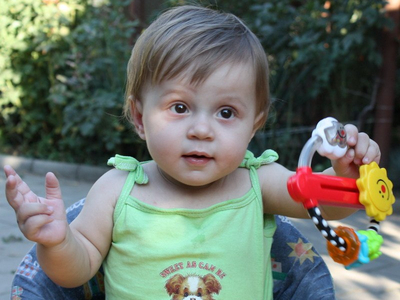




Nastia was born at term, at 40 weeks, weighing 3510 g. Length 51 cm. We were discharged on day 5 in satisfactory condition. There were practically no problems with the child until 6 months. At 6 months (February 2009) came a convulsive syndrome, found against a background of reduced calcium, 1,25 in the blood. We were in hospital; during the examination the parathyroid hormone level was 15 times above the norm; among the liver function tests the level of alkaline phosphatase, ALT and AST was raised, all the other readings were normal. The child became very irritable, with restless sleep because of heavy sweating, terrible constipation and itching skin. For 1,5 months we gave huge doses of calcium gluconate, but the calcium level still stayed below the norm at 1,53, ionised calcium 0.35. The calcium evened out with a therapeutic dose of vitamin D -2000 units (until May 2009) and calcium citrate 250 mg (until August 2009). Her general condition also improved. So at that time we thought of signs of rickets. The transaminase and alkaline phosphatase readings stayed practically the same throughout, the parathyroid hormone began to fall once the calcium rose, and the bilirubin readings were normal throughout. An abdominal ultrasound showed the liver not enlarged, but the gall bladder large and bent. From December her canine teeth began to come through, 4 at once without a temperature, but very painfully. To ease the pain we gave: nurofen, dentokind, paracetamol, efferalgan, dentol baby gel. On 18 January 2010, against a background of viral infection and teething, signs of obstructive bronchitis appeared without a rise in temperature. 7 days of treatment with an antibiotic (cefadex), claritin, inhalations with ventolin and flemoxin, ambroxol. And after that, about a week later, I noticed a slight yellowing of the eyes; we had liver function tests, which showed a raised bilirubin level of 55 because of the direct fraction, while the transaminase and alkaline phosphatase readings began to fall. The stool was pale, at times white, the urine dark. The colour of the skin gradually deepened and at times was coppery. Through the day the colour changed like a chameleon's. From that moment the bilirubin readings began to rise, and the transaminase and alkaline phosphatase readings began to return to normal. Why? We were sent to hospital and received treatment: intravenous drips of heptral, rheosorbilact, vit. C, cocarboxylase, coenzyme compositum, prednisolone, panangin, berlithion; per os ursofalk, luminal, vit. D and E, pangrol, duphalac, lactovit forte, magnesium B6. The condition improved. As the cause of the cholestatic hepatitis could not be diagnosed in Odesa, we were referred to Kyiv. At present the yellowing of the eyes and the colour of the skin remain, but the shade has changed to lemon. The urine is rarely deep lemon, mostly normal. The itching of the skin remains, but it wanders, now above, now below. Today we receive intravenous drips of: cytochrome, rheosorbilact, thiotriazoline, calcium gluconate, vit. C, lipoic acid, no-spa, prednisolone; per os ursofalk, vit. D and E, pangrol, luminal, bifiform, flamin, espumisan.