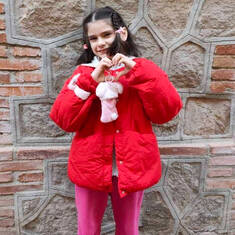

Liza was born a very active child. Since her childhood, she has been riding a scooter, rollerblading, skating, and cycling. At home, with her mom, she makes various animals and plasticine, draws, and weaves various figures of flowers, animals, and snowflakes out of flowers out of beads. She's friends with all the kids in the yard, very friendly and responsive. She attended choir at the district youth school, where Liza made many friends.
After finishing second grade, Liza felt ill. 27 An ambulance took her to the hospital, to the gastroenterology department, because she was nauseous and had a headache. A few days later, the head of the department decided to send the girl for a consultation to the Neurosurgery Department. There, a CT scan was performed, which revealed hydrocephalus. A shunt device was installed. The surgery was successful, and by the next day, Lisa was walking, eating, and sleeping.
Two weeks later, the girl was discharged from the hospital, and she resumed her normal life. Lisa received consultations from doctors at the Institute named after Romodanova. They were advised to monitor the tumor's growth dynamics. The child underwent a follow-up MRI, which showed that the tumor was growing. The parents went to a private clinic, where they promised to provide an answer after an MRI of the head and spine. But after
The parents were advised to seek treatment abroad, as the tumor was located very deep. A biopsy is dangerous, and surgery is impossible because there's a very high risk of the child becoming disabled. Radiation therapy and chemotherapy are needed. The girl's parents have sought treatment at foreign clinics because Liza needs comprehensive radiation therapy of her head and spine, and in our country, the machines irradiate one area first, and then the other. Everywhere they answered that the child should be in remission, meaning sit up and walk on her own. Unfortunately, Lisa — is currently unable to do this. She is currently unable to do this. Until
She was very active until recently. Everything changed 27 December 2016 Lisa suddenly became ill, and ambulance doctors took her to the hospital, where measures were taken to stabilize her condition. Lisa celebrated New Year's Eve in the hospital with her parents. They decorated a small Christmas tree for her, adorning it with colorful balls, candies, and gingerbread cookies, which they had baked in advance with Lisa at home for the Christmas tree.
2 In January, Lisa's condition worsened; she stopped walking and slept constantly. 3 In January, she had surgery, and since the girl hasn't been able to eat and drink, sit, or walk. Now she's regained her control, but can't take care of herself on her own.
Liza always celebrated Christmas in December at her grandmother and grandfather's. There, she would go to the neighbors to sing carols. Unfortunately, this year, the girl was unable to do so
The child's parents hope that Liza will receive help from caring people, and in next year she will be able to sing songs again and eat the kutia that the girl looks forward to every year at Christmas.
Despite our doctors' prognoses, professors at German clinics, after reviewing the examination results, reported readiness for surgery, since in their practice, such cases have occurred, surgical interventions were successful and led to the patient's recovery.
For assistance options, see here.